Biography
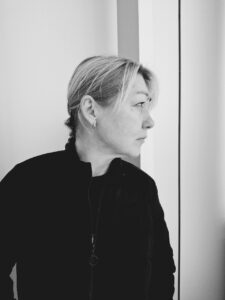
Vitale Kleveckaite (b. 1980, Kaunas, Lithuania) is a contemporary abstract expressionist, author, and the founder of the "Vitalism" art movement. Her distinctive creative practice exists at a highly intellectual intersection of fine art, literature, mythology, and deep parapsychological studies, shifting the paradigm of modern abstraction into a visual vessel for invisible lifeforce. Kleveckaite’s artistic journey is defined by a relentless, lifelong expand of her creative and academic horizons, mirroring the very essence of perpetual motion found in her philosophy. Her early foundation was shaped in Lithuania, where she pursued classical music studies in the Bassoon class at the J. Gruodis Conservatoire and engaged in intensive theater studio training. Seeking to broaden her cultural and intellectual landscape, she moved to Norway, where she expanded her academic path through studies at the prestigious Bergen University (Universitetet i Bergen) and deep musical immersion at the Grieg Academy (Griegakademiet). This rich, international, multi-disciplinary background infused her canvases with a distinct sense of rhythmic cadence, theatrical mystery, and narrative complexity. The structural foundations of her current visual philosophy emerged during her stay in Scandinavia, leading to her debut solo exhibition, "Playing With The Colours: Hieroglyphs" (2008, Norway), following creative consultations with the acclaimed Norwegian painters. In this early period, Kleveckaite initiated a profound visual meditation where raw, organic textures—such as sand and clay—met the ancient calligraphic fragments of Egyptian, Babylonian, and Arabic scripts. She recognized that unreadable ancient signs act as a portal to primordial memory, transforming pure color fields into spiritual codes. Today, her practice has evolved into a monumentally mature aesthetic phase known as Vitalism. Rejecting purely decorative abstraction, Kleveckaite uses heavy textures, deep structural contrasts, and shimmering metallic vectors to chart the continuous expansion and internal navigation of the human soul. Her institutional recognition reached a global milestone with the prominent exhibition of her curated capsule collection within the international "ANIMA MUNDI RITUALS" project at the historic Palazzo Albrizzi-Capello during the Venice event. Currently based in Lithuania, Vitale Kleveckaite continues to release highly sought-after, conceptually driven series—such as the Vital Currents collection—establishing her presence among discerning international collectors and premier contemporary art institutions worldwide.
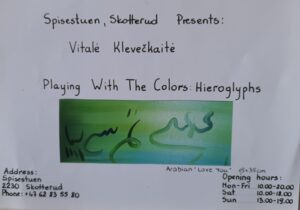
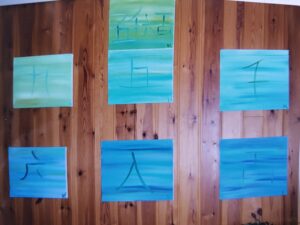
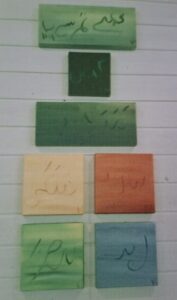
Exhibition " Playing With The Colours: Hieroglyphs" ( 4-th of September 2008)
In this Vitalės Klevečkaitės debut exhibition, works emerged where light and shadow converse quietly, yet profoundly.
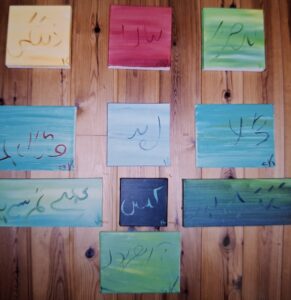
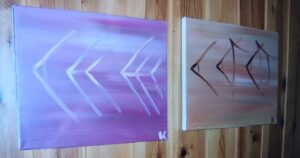
“Playing With The Colours: Hieroglyphs” is not only a debut show but also an invitation to a visual meditation, where color becomes language, and signs pulse between knowledge and mystery.
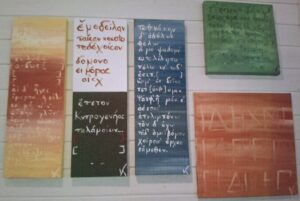
Here, minimalist intellectual expressionism, rooted in the ideas of Vitalism, speaks with the voices of ancient civilizations: the light of Egyptian sands, the depth of Babylonian clay, the discoveries of Chinese green and blue. Each color functions like a system of calculation, a written symbol, a mathematical formula known to our ancestors.
Echoes of Sappho’s lyricism and Arabic hieroglyphic inscriptions do more than reference history—they remind us that what we cannot read always appears to us as hieroglyphs, or perhaps as a secret waiting for its discoverer.